
Volume 1, Number 4 - Summer 1962
Report of Annual Meeting
Dr. Brownlee Addresses Historical Society, June 24, 1962
W. E. Freeland
Sunday, June 24, Dr. Richard Brownlee, Director of the Missouri Historical Society, ad dressed the White River Valley Historical Society at City Park, Forsyth, Missouri. He specifically dealt with the battle of Pilot Knob, September 27, 1864, but his overall theme considered thoughtfully the situation of the dying Confederacy at that time. As a result of patient research, he told how the Confederate Army was brought together from scattered elements, mostly from Arkansas and Missouri. The bitter feeling engendered in Missouri by the guerrilla warfare gave the Confederates hope that great numbers of Missourians would join in the effort, especially if the ragamuffin army could reach the section north of the Missouri River where Southern sentiment was strong.
The Confederate command was not well co-ordinated. Too many politicians were in the commanding group, with Joe Shelby perhaps the ablest leader but without final authority. The campaign into Missouri was well conceived from the Confederate viewpoint. The Confederacy was being strangled to death. In spite of terrible losses after the Battle of the Wilderness, Grant held Lee to fixed lines and denied Lee the opportunity of initiative which his genius always made effective.
Pilot Knob, generally passed over with a sentence or in silence by historians, thwarted the plan of the Confederates to break the barrier of the Mississippi that held the eastern and western Confederacy apart. Judged by number, it was only a skirmish but here, as everywhere in the struggle, the almost impossible task of taking fortifications by direct assault was found true.
[3]
The poorly equipped Southern army inexpertly directed, suffered terrific losses for the force engaged, and Federal General Ewing was able to withdraw his small force almost unscathed. Though Price was still to go on slashing across the state to Westport, he accomplished little. The detailed study of Dr. Brownlee is a tribute to patient and under standing historical genius. His "Gray Ghosts of the Confederacy" is a great contribution of a neglected study of one bitter phase of our Civil Conflict in Missouri.
President Elmo Ingenthron presided at the meeting. In his introductory remarks, he dealt briefly with the history of the site of Old Forsyth where the meeting was held. Mr. Ingenthron has rendered wonderful service to this entire area by his patient research into area history. He and the other outgoing officers have made the year no table in progress for the Society.
Judge J. R. Gideon, for the nominating committee, brought in the recommendations for officers for the ensuing year. They are: President, Dr. R. M. Good; 1st vice-president, R. L. Gideon; 2nd vice-president, Arch Mayden; Secretary, Elmo Ingenthron; Treasurer, Dorothy Standlee. New Directors elected were: for Stone County, Mary Scott Hair; for Christian County, Gene Geer.
Honorary membership was voted for Dr. M. C. Amyx, of Ozark County.
On invitation of Dr. M. Graham Clark, President of the School of the Ozarks, the next quarterly meeting of the Society will be held at the School of the Ozarks in September, with a dinner provided by the School.
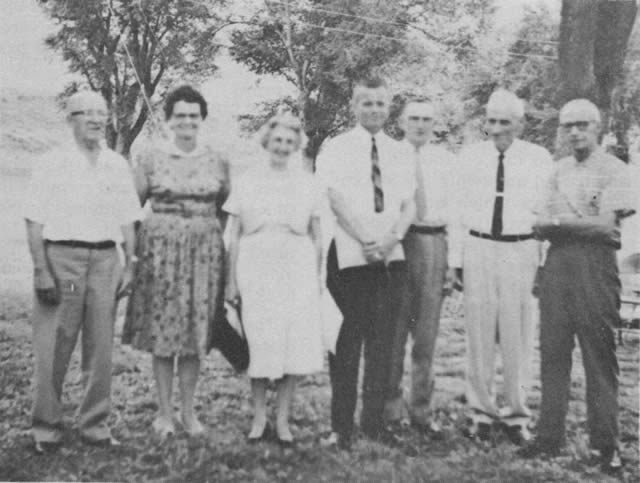
Newly elected officers and the guest speaker of the White River Valley Historical Society annual meeting held at Shadow Rock Park, June 24, 1962. L to R: Claude Hibbard, Ava, Director from Douglas County; Dorothy Standlee, Hollister, Treasurer; Mary Scott Hair, Hurley, Director from Stone County; Dr. Richard Brownlee of the State Historical Society at Columbia guest speaker; Elmo Ingenthron, retiring President and elected Secretary; Dr. H. M. Good, President Emeritus of the School of the Ozarks, incoming President; and Gene Geer, Director from Christian County.
[4]
This volume: Next Article | Table of Contents | Other Issues
Other Volumes | Keyword Search | White River Valley Quarterly Home | Local History Home
Copyright © White River Valley Historical Quarterly
