HISTORICAL POSTCARDS OF SPRINGFIELD, MISSOURI
Convention Hall (view 1 of 2)
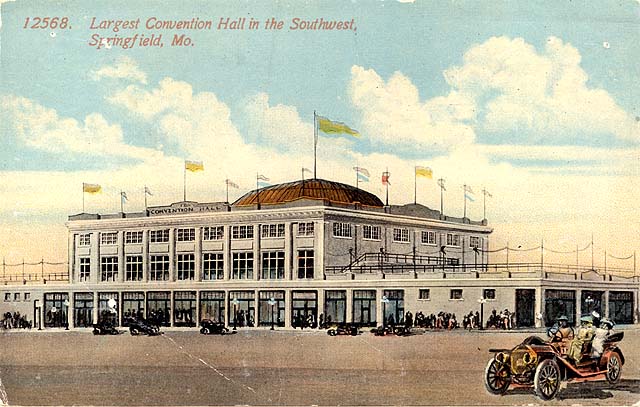 This view of Springfield's Convention Hall is an architect's embellished drawing, probably one of the hundreds of postcards given to visitors of the building when it was opened to the public for inspection on May 15, 1913.
The huge three-story convention center was built in 1913 on the west side of South Campbell Avenue between Walnut and College Streets near the Old Calaboose. It began in 1912 with a movement by the Manufacturers and Jobbers Association to finance the building with money raised through private stock subscriptions. Area merchants hoped a convention center would attract business to Springfield. The city of Springfield owned the land on which the Convention Hall stood. A 50-year lease on the lot was given to the Convention Hall Association.
The cost to build the Hall was $95,000. The first floor was mainly used for market booths selling fruits, vegetables, dry goods, dairy products and baked goods. It also contained the lobby and business offices. The auditorium covered the entire second floor and could seat 4,000. A balcony comprised the third floor. Miss Grace Leard, a vaudeville performer and sister to Mrs. Otis Milligan (a prominent Springfield grocer), sang for the entertainment of the estimated 10,000 visitors at the building's opening.
The building never raised enough revenue to cover expenses and could not compete with the new Abou Ben Adhem Temple auditorium. It was closed down in 1933.
The lot of land the Convention Hall was built on had a colorful history before the Hall was ever built. It was originally owned by prominent Springfieldian William Fulbright. He sold it to Daniel D. Berry who built a log cabin on the site. The lot later came to be used as a public speaking ground. A famous 1856 speech by Thomas Hart Benton denouncing then-congressman John S. Phelps was delivered on the lot. Before the Convention Hall was built, the lot was a trading center, a place to camp and a general gathering place for swapping tales.
Postcards Home | Keyword Search | Local History Home