HISTORICAL POSTCARDS OF SPRINGFIELD, MISSOURI
First Congregational Church
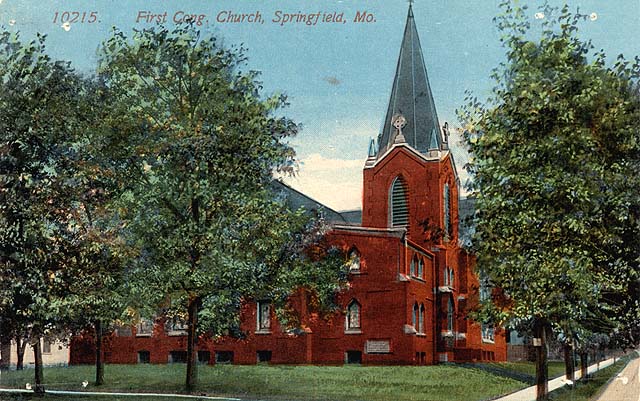 The First Congregational Church in Springfield was founded in 1869. Charles Harwood moved to Springfield from Vermont and went into the real estate business. Soon his brother James H. Harwood, a Congregational minister, came to Springfield along with other relatives. Ten members of the Harwood family and Dr. Edwin T. Robberson, who later became a prominent Springfield physician, organized a church called the Union Evangelical Church. James Harwood was pastor. After a year the church had 38 members. In 1870 members voted to change the name of the church to First Congregational. Also in 1870 church members purchased two lots at the northeast corner of Jefferson Avenue and Locust Street for a church. A small frame structure was built.
In addition to First Congregational Church activities the Springfield Association of Congregational Churches met. This association included Congregational churches from Lebanon, Barton City, Carthage, Neosho and Springfield. This was the group that created Drury College (now University). There was a rivalry among ten towns wanting the college and Springfield won by a single vote.
After 1900 First Congregational church needed a bigger building. There was also a desire among the church members to be closer to Drury College. Two lots at Benton Avenue and Calhoun Street were purchased and a large red brick structure was built. This is the church building in the postcard. The first service was held on May 29, 1904.
On January 12, 1952, a tragic fire struck the church, completely destroying it. Among the items lost in the fire were a valuable oil painting, a new organ, walnut doors and a lectern. The church bell was saved. A new church was built on the site in a contemporary style. In 1957 the national council of the Congregational Church merged with the Evangelical and Reformed Church and the name changed to First Congregational, United Church of Christ. The most recent article about the church in the Springfield News-Leader is from 1990. The church wanted to publicly invite all members of the gay community in Springfield to attend the church, where they would be welcomed.
Postcards Home | Keyword Search | Local History Home