SPRINGFIELD, MISSOURI AND SURROUNDINGS • 1889

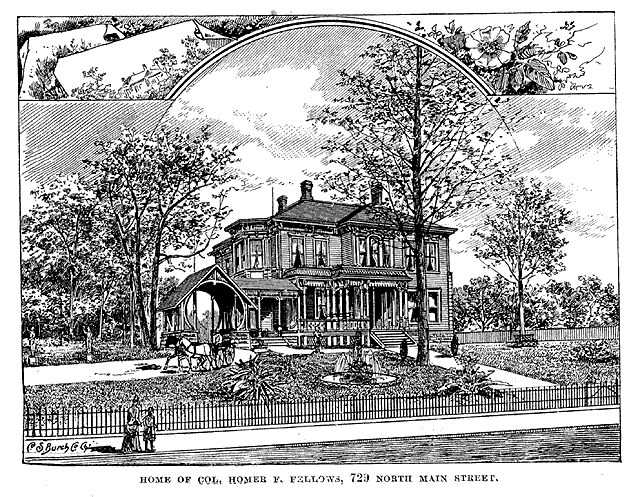
(previous page) whole covering an area of about 25,000 square miles, which is fairly TRIBUTARY TO SPRINGFIELD, is undoubtedly the most inviting and promising field for settlement and investment to be found between the two oceans. It lies along and contiguous to the Ozark range, with a mean altitude of 1200 feet above the tides, and with its rare, clear, invigorating atmosphere, long, genial, growing summers, with bright breezy days and deliciously cool restful nights; its short, dry open winters, and equable mean temperature of 55 degrees, has unquestionably THE FINEST CLIMATE on the continent, a climate representing the equable mean between the rigors of the colder North and the depressing heat and humidity of the lower South. The pure life-inspiring atmosphere, pure water and freedom from swamps, lagoons and other malaria-breeding influences, give this beautiful region THE HIGHEST DEGREE OF HEALTH known to any really good agricultural country on the continent, which is a matter of primary importance to the new settler. THE FACE OF THE COUNTRY is singularly attractive. It is a happy union of graceful billowy prairie, wooded hills and table lands, rugged picturesque wooded bluffs, beautiful winding valleys, coursed by clear rapid streams, bold rocky cliffs and headlands, well wooded glens and canyons, and green grassy glades and intervales, the whole blending in A MATCHLESS LANDSCAPE in which is no semblance of weariness, or monotony, nothing abstract or startling, but everywhere unity and harmony in endless variety. The Ozark range has none of the rugged grandeur of the mountains, but is rather a great divide or water shed, reaching from the Black River country, in Southeastern Missouri, to the “Flint Hills” of Middle Central Kansas, and for the most part smooth enough for agricultural uses, not more than 20 per cent. of the entire region outlined being too rough and rocky for cultivation. SPLENDID FORESTS of oak, elm, ash, hackberry, hickory, sycamore, white and black walnut, cottonwood, linden, yellow pine, honey locust, pecan, mulberry, box elder and kindred woods, cover fully half of this great region, and lumbering for local use and export is one of the leading industries, notably so in the hard pine districts, along the “Gulf” Railway, where it involves scores of fine mills, thousands of laborers and hundreds of thousands of dollars of active capital. SUPERB BUILDING STONES are found in every portion of the country, among them blue and gray limestones, gray, brown and red sandstones, and in some localities, fine varieties of granite and marble. The manufacture of white lime from the remarkably pure carbonate rocks, like the lumber interest, is carried to fine proportions, especially along the “Gulf” road, from Lamar to Springfield. Vast deposits of FIRE AND POTTERS’ CLAYS of the finest quality are found in nearly every county, and at several points are extensively used in the manufacture of tile, sewer pipe, pottery, etc., etc. The LEAD AND ZINC mines of this region are the richest in the known world, and though in the infancy of development, involve millions of invested capital, a good sized army of laborers, and millions of dollars in their yearly output, which practically governs the lead and zinc market of the country. There is LEAD AND ZINC EVERYWHERE, in every county and township within the great radius above outlined. The lead and zinc mining camps about Joplin, Granby, Galena, Webb City, Aurora and a dozen other points that have become great bee-hives of industry, whose annual output of these metals runs up into hundreds of thousands of tons, are but modest prototypes of hundreds of other camps more recently opened and now in prospect, where even superficial developments disclose the leads to measureless mineral wealth. Mr. Stephen C. Johnston, a practical miner of many years experience, who has been looking into the mineral resources of Green and neighboring Counties, says that Springfield is central to a mineral bearing district extending over a radius of twenty miles, embracing what (next page)
Page
1 | 2 | 4 | 5 | 6 | 7 | 8 | 9 | 10 | 11 | 12 | 13 | 14 | 15 | 16 | 17 |
18 | 19 | 20 | 21 | 22 | 23 | 24 | 25 | 26 | 27 | 28 | 29 | 30 | 31 | 32 | 33 | 34 | 35
Springfield 1889 Home | Keyword Search | Engravings Thumbnails | Local History Home
