HISTORICAL POSTCARDS OF SPRINGFIELD, MISSOURI
Frisco Office Building
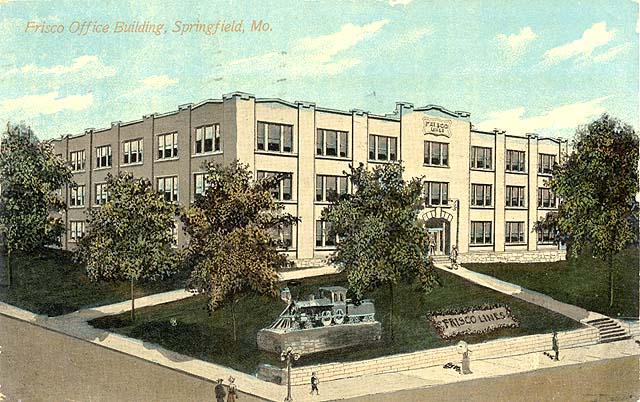 The famous Frisco (St. Louis-San Francisco Railway) coonskin logo is clearly visible on the front of the building in this 1911 postcard. Springfield had historically been the communications and operating hub of the railway and the Frisco was both Springfield's largest employer and highest taxpayer.
The Frisco Building, built in 1910 on the northwest corner of Jefferson and Olive as the headquarters for the Frisco Railway, was one of three buildings opened to the public for examination on February 2, 1911. The other two buildings were the Woodruff Building and the Republican Building. A special supplement to the Springfield Republican newspaper was devoted to the "Trinity of Noble Buildings" on February 3, 1911. The architect, F.W. Hunt, told the building's owners that the "structure ought to stand practically unimpaired for 500 years."
Huge crowds visited the building during the open house, lured by the novelty of seeing the workings of a railway office and the majesty of the building. The postcard depicts a small railroad engine on the lawn. This miniature engine, originally built for the St. Louis World's Fair in 1904, was actually displayed on the third floor of the building and was a popular attraction for the visitors.
The building is "L" shaped and was constructed of reinforced concrete with brick walls. There are 37,000 feet of floor space within the four floors and basement. A 10-foot tall penthouse sits atop the structure. The building housed the offices of the Frisco Railway until 1964 when a new building was constructed near Mill Street and Ingram Mill Road. The addition of 400 Frisco jobs in Springfield necessitated this move.
Renamed the Landmark Building in 1966 to commemorate John Polk Campbell's 1829 claiming of the property by carving his initials in the bark of an ash tree, the site was also home to Springfield's first school. The Center (later Central) School occupied a building on the site from 1867 until 1908, first as Springfield's first high school and from 1893 to 1908 as a primary school. The building was razed in 1909 to provide a site for the Frisco Building.
The Landmark Building still stands as testament to the architect's prediction and is now one of Springfield's largest multi-tenant facilities.
Postcards Home | Keyword Search | Local History Home